
Meta officially publishes the AI ad ranking roadmap
Meta's official announcement on 2025-03-27. Four AI ranking innovations explained to advertisers:
- Meta GEM — "Super Brain" (central foundation model)
- Meta Lattice — "Giant Library" (unified ranking architecture)
- Meta Andromeda — "Supercharged Retrieval" (candidate ad search)
- Creative Likelihood Estimator (CLE) — "Smart Predictor" (creative performance prediction)
Each plays a different role. They interlock to keep improving "ad relevance and personalization."
Source: Meta Business News — AI Innovations in Meta's Ads Ranking
1. GEM — central foundation model
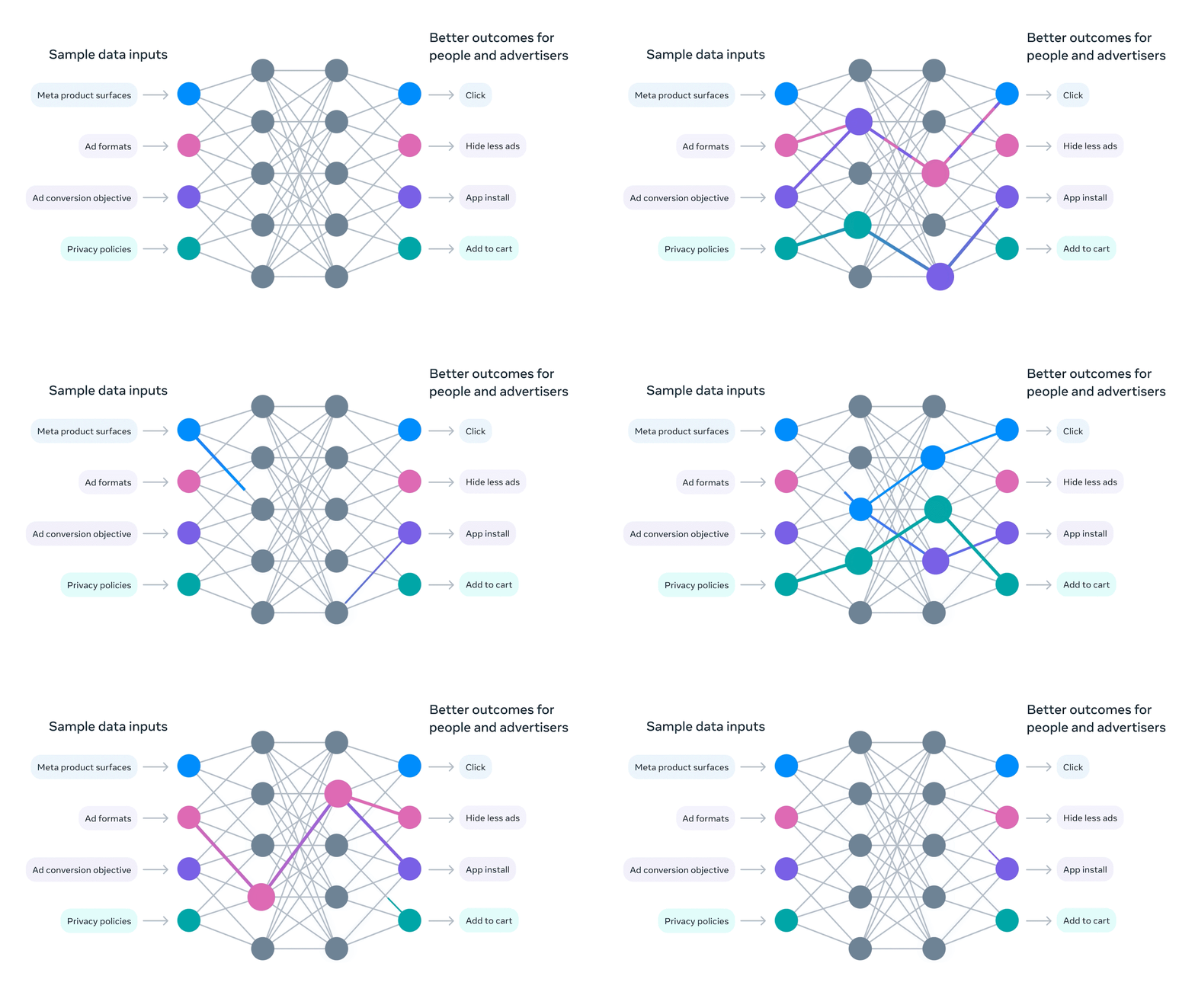
Role: An ads foundation model trained at LLM scale (thousands of GPUs). Downstream models inherit knowledge from GEM — the "central brain."
Numbers: Initial Reels rollout drove up to +5% conversions.
Analogy: A massive super brain. Reads an entire library in seconds, maps every character's relationships, and instantly understands a user's behavior sequence.
2. Lattice — unified ranking architecture
Role: Previously, Meta ran dozens of small models per "campaign objective + placement." Lattice consolidates them into one large model.
Effect: Efficiency + performance gains. The larger model understands the entire buying journey as a single context — connecting "this person saw fitness content on Instagram and clicked a health food ad on Facebook" into one recognition.
Analogy: Previously, history and art libraries were separate. Now a single unified library. The librarian instantly connects "this topic" to "that related topic."
3. Andromeda — candidate ad retrieval engine
(Covered in a separate post — see the Andromeda rollout article.)
Role: Retrieves tens to hundreds of thousands of candidate ads and evaluates them in one pass.
Effect: The underlying reason accounts with creative variety now have the edge.
4. Creative Likelihood Estimator (CLE) — creative performance prediction
Role: Predicts in advance how well a creative will perform for a specific person. Even if advertisers upload creatives in bulk, Meta quickly judges "who to show what."
Effect: Directly coupled with Advantage+ Creative. Even when generating AI creative variations at scale, CLE filters them — efficiency holds.
The full picture — how the four interlock
[User opens the app]
        ↓
[Andromeda] Retrieves hundreds of thousands of candidate ads
        ↓
[Lattice] Evaluates with unified context (full funnel sequence)
        ↓
[GEM] Final relevance prediction with central knowledge
        ↓
[CLE] Applies per-creative performance prediction
        ↓
[The best-fit ad for this user]
So 4 AIs fire in sequence for a single user impression decision. You can see why Meta pushes Advantage+ and automation — Advantage+ is the way to maximize the 4-tier AI chain's benefits.
What advertisers actually feel
1. Reading the numbers: Meta's "5% improvement" figure is internal-experiment based. In real accounts, the felt impact is typically 1–3%. And only on accounts with high Advantage+ share.
2. Direction: As AI gets smarter, input quality matters more. Garbage event data yields garbage results even through 4 AI stages.
3. Limits of manual operation: The 4-AI chain applies to manual campaigns too, but only partially. It's maximized in the Advantage+ lineup. Future conversion competitiveness will be determined by Advantage+ proficiency.
So what do we do?
Checks:
- [ ] Advantage+ Audience, Placement, Campaign Budget — all three on?
- [ ] Pixel + CAPI together, EMQ 7+ maintained?
- [ ] 3–5 creatives running per ad set?
- [ ] Event sequence (ViewContent → AddToCart → Purchase) complete?
- [ ] Advantage+ Sales campaigns over 50% of spend?
All five met: You're getting the benefits of Meta's 4-AI chain. CPA and ROAS should keep improving steadily.
Three or fewer met: The AI can't work in this environment. Reinforce each check, one at a time.
What's coming
Meta says "this isn't the end." New models and architectures are scheduled for staged release across 2026–2027. When autonomous agents like REA enter the mix, algorithm update cycles will shorten to monthly.
Meaning: "Perfectly setting up my account" matters less than an operational rhythm that adapts fast to change.
Meta's AI roadmap and practical performance optimization responses are covered in Meta Ads Book 4.