Stackalone
Stackalone
Books
ConsultingBlogMissionFAQContact
Stackalone

Links

  • Books
  • Mission
  • FAQ
  • Contact

Contact

  • hello@stackalone.com
  • 651 N Broad St, Suite 201
    Middletown, Delaware 19709, United States
Privacy PolicyTerms of Service

© 2026 Stackalone. All rights reserved.

← Meta Blog
Meta·Update·Dec 5, 2024

Sequence Learning — Event Order Is Now Part of the Ads Model

Meta's ads recommendations shifted from "thousands of features" to "user event sequences." 2–4% conversion lift for specific segments. Event quality matters even more.

Meta Sequence Learning — a paradigm shift in ads recommendations

Meta ads recommendations quietly got rebuilt end-to-end

Nov 19, 2024, Meta Engineering blog. The phrase that jumped out: "paradigm shift." This is the official announcement that the foundational structure of the ads recommendation system has changed.

The old way: DLRM on thousands of features

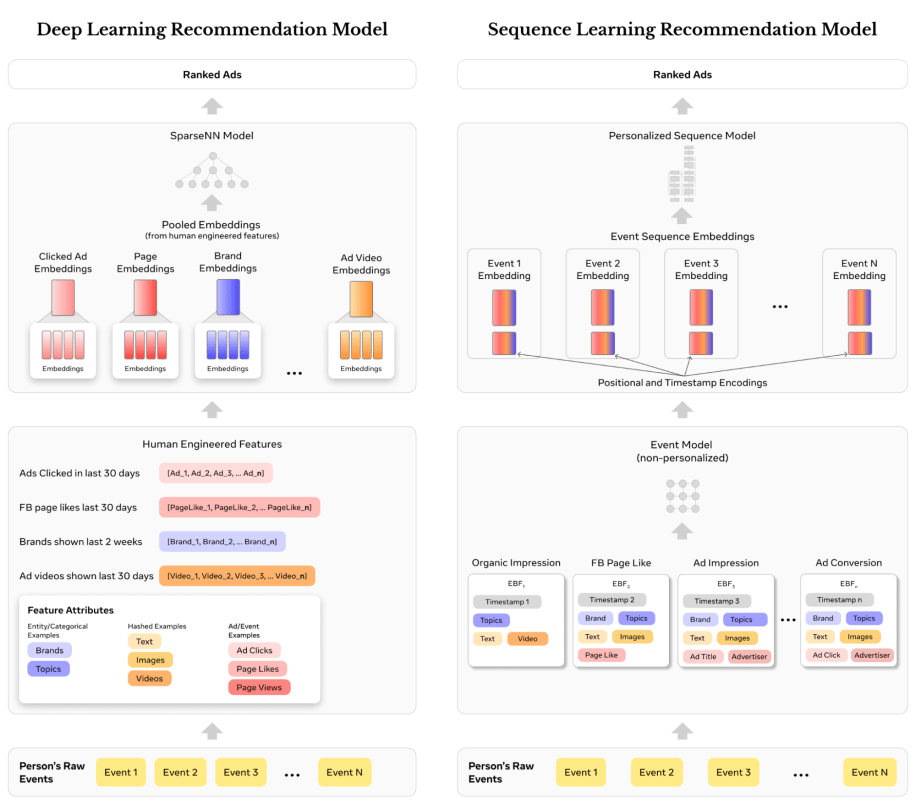
Meta's previous ads recommendation ran on DLRM (Deep Learning Recommendation Model). How it worked:

  • User profile → converted into thousands of hand-designed features (interests, behaviors, etc.)
  • Vectors like "fitness interest 0.8, food interest 0.6, 7-day activity score 0.5..."
  • DLRM predicted "probability this user likes this ad" from the vector

The problem: order is lost. A user searches Nike shoes yesterday → reads Adidas reviews today → is on a running blog 30 minutes ago. That time order is what signals purchase intent, but DLRM treated it as "interested in all three."

Source: Meta Engineering — Sequence Learning: A paradigm shift

The new way: event-sequence based

Event sequence learning — Meta's new recommendation structure

What Meta rolled out is Sequence Learning. Two shifts:

  1. Event-based learning — instead of hand-designed features, learn directly from the user's actual engagement and conversion events
  2. Sequence learning architectures — replace DLRM with sequence models used in NLP and Computer Vision (transformer family)

Just as NLP understands sentence meaning through word order, the Meta ads system now understands purchase intent through user event order.

Actual lift

Meta's official figures: 2–4% conversion lift in specific segments. Not the overall average — 2–4% "in well-matched segments." For advertisers, this means:

  • Accounts already on Advantage+ Shopping Campaigns → benefit naturally
  • Manual campaigns benefit too, but relatively less
  • Industries with long purchase journeys (B2B, high-ticket) gain the most (longer sequences, more information)

What changes for advertisers?

Core: event data quality and order now matter much more than before.

1. Event "order" is now data value

Before: firing the Purchase event cleanly was enough.

Now: ViewContent → AddToCart → InitiateCheckout → Purchase must arrive as a complete sequence for Meta to learn the pattern. Accounts with missing mid-funnel events break the sequence and lose the benefit.

2. Mid-funnel events finally matter

AddToCart and InitiateCheckout used to be treated as "reference data." Now they're core to sequence richness. For ecommerce, all mid-funnel events need to be implemented.

3. Event timestamp accuracy matters

Sequences are based on time order. Large event-send delays scramble the order. This is why Conversions API (CAPI) matters more in practice — it has less delay than the Pixel and is more stable.

So where does that leave us?

Checklist:

  • [ ] Implement all 5 events: ViewContent, AddToCart, InitiateCheckout, AddPaymentInfo, Purchase
  • [ ] Include value, currency, and content_ids parameters on each event
  • [ ] Run Pixel + CAPI in parallel (deduplication event_id is required)
  • [ ] CAPI events sent within 5–30 seconds of occurrence (automatic with Shopify CAPI Gateway)
  • [ ] Maintain Event Match Quality of 7.0+ in Events Manager

Hit all 5 and you get Sequence Learning benefits naturally. Miss one and the "2–4% conversion lift" doesn't apply to your account.

What not to do:

  • Replacing Purchase with a custom event (Sequence Learning optimizes around standard events)
  • Batch processing events (real-time sending is required; once-daily batch uploads break the sequence)

One caveat

Meta's "2–4% conversion lift" is Meta's own measurement. The ROAS you see in GA, Northbeam, or other third-party tools may differ. The direction is real, but don't take the number at face value.


The structural framework for Pixel, CAPI, and event-quality management is covered in Meta Ads Book 5.

Run Your Campaigns in 2 Hours a Week

Meta Ads on Autopilot

Stackalone

Covered in depth in
Meta Ads on Autopilot
Run Your Campaigns in 2 Hours a Week
→
Tags
#sequence-learning#dlrm#algorithm#pixel
← Previous
2024 Privacy Regulation Trends — EU DPF, California, Korea PIPA
Nov 18, 2024
Next →
Can ChatGPT Replace Ad Copy? — A 3-Month Experiment
Dec 16, 2024

Related Topics

  • Update · Apr 13, 2026
    Andromeda Rollout — What's Changing in Your Account
    #andromeda#algorithm#advantage-plus
  • Update · Apr 6, 2026
    GEM — Meta Ads AI's "Central Brain," and What Changes for You
    #gem#advantage-plus#andromeda
  • Update · Mar 20, 2026
    REA — An AI Agent Is Replacing Meta's Ranking Engineers
    #rea#algorithm#ai-agent
  • Update · Jun 2, 2025
    Instagram's 1000-Model Era — How Fast the Recommender Learns
    #instagram#ml-models#algorithm